


ADRESSES
- 2304 Memorial Pkwy SW,
Huntsville, AL 35801 - 427 2nd Avenue SW, Suite
102, Cullman, AL 35055 - 112 West Market St.,
Athens, AL 35611 - 217 Randolph Ave SE,
Huntsville, AL 35801
Expungements
Expunge Your Criminal Record
Expungement Lawyers | Crumbley-Blackwell-Price Attorneys
In Alabama, expungement laws are very stringent. Only individuals who have been charged without conviction of a misdemeanor or non-violent felony may erase their records.
Misdemeanors and other violations are eligible if the defendant was found not guilty, if the charge was dismissed with or without prejudice more than 2 years ago (and was not refiled), or if the charge was no-billed by a grand jury.
Only non-violent felonies are eligible for expungement if there was not a guilty verdict, dismissed charges, or no-billed charges. Also, defendants who completed a diversion program or were not convicted of any other crimes (with an exception of minor traffic violations) within the last five years are also eligible for expungement in Alabama.
-
 practice link
DUI Expungements
If you were charged with a crime as an adult in Alabama, then you should be aware that there are police and court records about your arrest and court case, even if you were found not guilty or the charges were disposed of in your favor. There is good news, though, because in April of 2014 the Alabama Legislature passed a new expungement law.
Are there felony criminal charges that cannot be expunged?
Individuals are not eligible for expungement if they were convicted of violent felonies that are included in the Alabama Code, such as:
- Arson
- Assault
- Burglary
- Robbery
- Domestic violence*
- Kidnapping
- Stalking
- Sex Related Crimes
- Murder or manslaughter*Alabama misdemeanor charges for domestic violence may still be expunged.
Clear Your Criminal Record Today
If you would like your criminal record to be expunged, please contact an expungement attorney to discuss your situation. We offer free phone, video, and office consultations for all expungement cases in Alabama! During your initial consultation – we’ll review the details of your criminal record and inform you of whether or not you’re eligible for an Alabama expungement. Schedule your free consultation today by calling our Huntsville/ Athens location at (256) 539-4464 or completing an online case evaluation form.
contact us about your case
Still have questions? Schedule a consultation with a lawyer from our team today by calling or completing an online form
CONTACTS
OR
ADDRESS
- 2304 Memorial Pkwy SW, Huntsville, AL 35801
- 112 Market Street W., Athens, AL 35611
- 427 2nd Avenue SW, Suite 102, Cullman, AL 35055
- 5500 Southlake Park Suite 200, Birmingham, AL 35244
find us
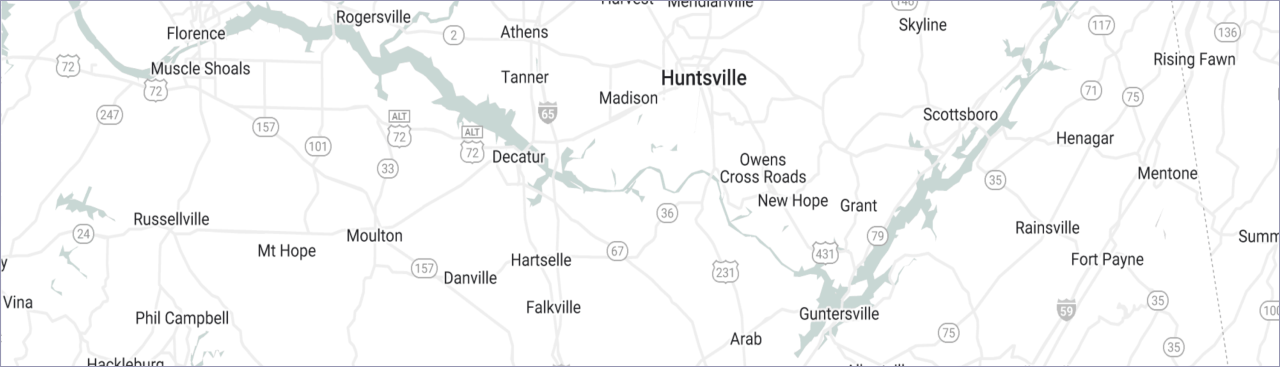
Athens office
Address: 112 Market Street W., Athens, AL 35611
Phone (English): (256) 539-4464
Google map: https://goo.gl/maps/zbu296X2SNZUi6Tr6
Huntsville
Address: 217 Randolph Ave SE, Huntsville, AL 35801
Phone (English): (256) 539-4464
Google map: https://goo.gl/maps/Li7ndJFe9u7amwQx7
Huntsville
Address: 2304 Memorial Pkwy SW, Huntsville, AL 35801
Phone (English): (256) 539-4464
Google map: https://goo.gl/maps/JrumnQm5GT4rj4j97
Cullman
Address: 427 2nd Avenue SW, Suite 102, Cullman, AL 35055
Phone (English): (256) 539-4464
Google map: https://goo.gl/maps/NLDEo3KUFMoLawMA8

huntsville offices
Main: 2304 Memorial Pkwy SW, Huntsville, AL 35801
256-539-4464
athens office
112 Market Street W, Athens, AL 35611
256-539-4464
Cullman office
427 2nd Avenue SW, Suite 102, Cullman, AL 35055
256-539-4464
© 2026. All Rights Reserved. Made with  by DD.NYC
The information on this website is for general information purposes only. Nothing on this site should be taken as legal advice for any individual case or situation. This information is not intended to create, and receipt or viewing does not constitute, an attorney-client relationship. While this firm maintains joint responsibility, most personal injury cases are referred to other attorneys for principle responsibility. Prior success is not an indication of future success. Every case is different and regardless of what friends, family or other individuals may say about a case, each case must be evaluated on its own facts and circumstances as they apply to the law. The likelihood of success in any given case depends on the facts, the jurisdiction, the venue, the witnesses, the parties and the testimony, among other factors. Furthermore, no representation is made that the quality of legal services to be performed is greater than the quality of legal services performed by other lawyers. Bankruptcy Disclaimer: We are a debt relief agency. We help people file for bankruptcy relief under the Bankruptcy Code.