


ADRESSES
- 2304 Memorial Pkwy SW,
Huntsville, AL 35801 - 427 2nd Avenue SW, Suite
102, Cullman, AL 35055 - 112 West Market St.,
Athens, AL 35611 - 217 Randolph Ave SE,
Huntsville, AL 35801
Video FAQs
-
Criminal Defense
Absent a Warrant for Your Arrest on a Misdemeanor, Can a Police Officer Arrest You?
Absent a warrant for your arrest on a misdemeanor, a police officer cannot arrest you. To arrest you on a misdemeanor, the police officer actually has to have seen you commit the crime. There are a few exceptions to that, but that is the general rule. Typically, what they're going to do is tell someone who claims to be a victim that they will need to go to the magistrate and issue a warrant themselves.
-
Can police officers ask you questions if you're not under arrest?
Typically, that's exactly how these investigations begin. So, the police officer can ask you questions and if you are not yet in custody, they don't have to read you your Miranda right. The safest thing for you to do if you are concerned is simply ask the officer, "Am I under arrest or am I free to go?" And if you're under arrest now, you're entitled to Miranda and a lawyer. Now, if you're not under arrest, then you're free to go. Whether you answer those questions or not simply is up to you. Our recommendation is always exercise your right to remain silent.
-
Can Police Search Your Car Without Probable Cause?
What if the officer searched but didn't have probable cause? That would constitute an unconstitutional search. In that scenario, the evidence obtained is inadmissible in court. And if that evidence doesn't come into court, then they don't have a case. One of the things our firm will do is make sure that probable cause was properly established. And if not, we'll file motions to suppress the evidence. If the evidence goes, so does your case.
-
The police want to look at your phone, do you have to let them?
If you're under investigation and the police want to look at your phone, do you have to let them? The answer is no. The police officer has to either have your permission or a search warrant to get into your phone. They have to have a search warrant to seize your phone and they have to have a search warrant to enter the contents of your phone. So, you don't have to let them. You don't have to give them permission. Just like you don't have to let them search your house without a search warrant. Just like you don't have to let them draw blood without a search warrant. Those things are constitute searches and for all searches they either have to have permission or a search warrant and they have to have probable cause to get a search warrant.
-
Can Police Use Evidence Found in an Illegal Search?
What happens to evidence that is seized pursuant to an illegal search? Well, the case law in Alabama is clear. If the search and seizure were unlawful, the evidence collected pursuant to that unlawful search is due to be suppressed. What that means is the prosecutor can't bring it into evidence at trial. They can't even comment on it at trial. What does that mean? Typically, it means case dismissed.
-
Can Cops Pull You Over and Refuse to Tell You Why?
You are either in custody or you are free to leave. If you are in custody, you are now entitled to the presence of a lawyer and you are entitled to your Miranda warning. At that point, they're either going to have to arrest you and take you to jail or you call their bluff, you're not under investigation, and they let you leave. Police officers use what is called a ruse. The rest of us call it lying, but they're allowed to do that to try to get you to talk. Always remember, don't talk. Am I in custody, officer, or am I free to leave?
Need to speak with a Criminal Defense Lawyer?
Our law firm has decades of combined experience defending cases in North Alabama relating to criminal defense and DUI defense. Free phone and office consultations available today.
This page does not provide legal advice and does not create an attorney-client relationship. If you need legal advice, please contact an attorney from our team to schedule a consultation. Furthermore, no representation is made that the quality of legal services to be performed is greater than the quality of legal services performed by other lawyers.
contact us about your case
Still have questions? Schedule a consultation with a lawyer from our team today by calling or completing an online form
CONTACTS
OR
ADDRESS
- 2304 Memorial Pkwy SW, Huntsville, AL 35801
- 112 Market Street W., Athens, AL 35611
- 427 2nd Avenue SW, Suite 102, Cullman, AL 35055
- 5500 Southlake Park Suite 200, Birmingham, AL 35244
find us
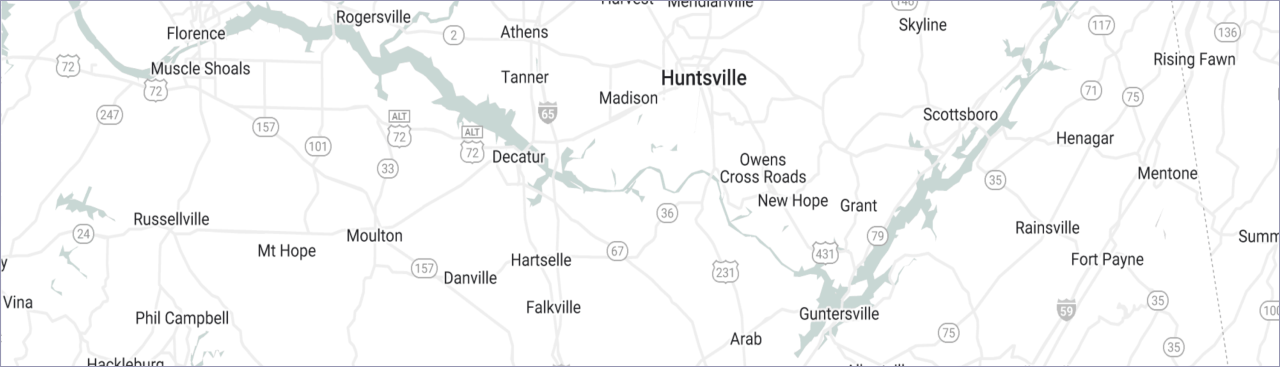
Athens office
Address: 112 Market Street W., Athens, AL 35611
Phone (English): (256) 539-4464
Google map: https://goo.gl/maps/zbu296X2SNZUi6Tr6
Huntsville
Address: 217 Randolph Ave SE, Huntsville, AL 35801
Phone (English): (256) 539-4464
Google map: https://goo.gl/maps/Li7ndJFe9u7amwQx7
Huntsville
Address: 2304 Memorial Pkwy SW, Huntsville, AL 35801
Phone (English): (256) 539-4464
Google map: https://goo.gl/maps/JrumnQm5GT4rj4j97
Cullman
Address: 427 2nd Avenue SW, Suite 102, Cullman, AL 35055
Phone (English): (256) 539-4464
Google map: https://goo.gl/maps/NLDEo3KUFMoLawMA8

huntsville offices
Main: 2304 Memorial Pkwy SW, Huntsville, AL 35801
256-539-4464
athens office
112 Market Street W, Athens, AL 35611
256-539-4464
Cullman office
427 2nd Avenue SW, Suite 102, Cullman, AL 35055
256-539-4464
© 2026. All Rights Reserved. Made with  by DD.NYC
The information on this website is for general information purposes only. Nothing on this site should be taken as legal advice for any individual case or situation. This information is not intended to create, and receipt or viewing does not constitute, an attorney-client relationship. While this firm maintains joint responsibility, most personal injury cases are referred to other attorneys for principle responsibility. Prior success is not an indication of future success. Every case is different and regardless of what friends, family or other individuals may say about a case, each case must be evaluated on its own facts and circumstances as they apply to the law. The likelihood of success in any given case depends on the facts, the jurisdiction, the venue, the witnesses, the parties and the testimony, among other factors. Furthermore, no representation is made that the quality of legal services to be performed is greater than the quality of legal services performed by other lawyers. Bankruptcy Disclaimer: We are a debt relief agency. We help people file for bankruptcy relief under the Bankruptcy Code.